Short answer
A soil carbon credit typically sells for about €15 to €60 per tonne of CO₂e in European deals (Senken, Sept. 2026). In the US, listed prices run from about $50 per tonne (Indigo Ag) to about $81 per tonne (Carbonmark, Oct. 2026). Where a credit lands in that range depends on its methodology version and CCP label, how precisely soil carbon was measured, permanence safeguards, vintage and region, and documented co-benefits.
- Soil carbon sits mid-market: above forestry avoidance credits, below durable removals such as biochar.
- Integrity is the entry ticket: CCP-labeled, well-rated credits now command a measurable premium.
- Measurement is the lever developers control most: lower uncertainty means more credited tonnes and a stronger price story.
- Co-benefits are the tie-breaker: they can add several euros per tonne once integrity is proven.
Last updated: November 2026
A tonne of carbon stored in farm soil is a tonne of carbon. So why can one soil carbon credit sell for €15 while another, from a similar farm, fetches several times as much?
Carbon credit prices do not follow commodity rules. In a study of more than 7,200 transactions, MIT Sloan researchers found that the buyer’s identity alone explained 62% of price differences, and that some of the most expensive credits came from projects with weaker climate-impact ratings (MIT Sloan, July 2026). For soil carbon, the rest of the gap comes down to five factors. This guide explains each one, and what buyers and project developers can do about them.
How much is a soil carbon credit worth in 2026?
In 2026, regenerative agriculture credits trade between €15 and €60 per tonne in European deals, according to transaction and forward-offer data from Senken, a European carbon credit buyer. US listed prices are thinner and sit higher: on Carbonmark, a US marketplace, the one soil carbon project with available supply (an agroecology project in Italy) was listed at about $81 per tonne in October 2026, and Indigo Ag lists credits from its Climate Action Reserve project CAR1459 at $50 per tonne on its own store (Indigo Ag). That places soil carbon in the middle of the voluntary market: well above legacy avoidance credits, below durable engineered removals.
| Credit type | Removal or avoidance | Carbonmark lowest listing per project, USD/t (Oct. 2026) | Senken transactions and forward offers, €/t (Sept. 2026) |
|---|---|---|---|
| Renewable energy | Avoidance | $0.10–$3 | — |
| Forestry (REDD+, reforestation and mangroves) | Avoidance or temporary removal | $2–$38 | €12–€50 |
| Agriculture & soil carbon | Removal + reductions | ~$81 (one project listed) | €15–€60 |
| Biochar | Durable removal | ~$100 | €105–€200 |
Sources: Carbonmark, cheapest purchasable listing per project across the 64 projects with supply, updated October 26, 2026 (the soil carbon figure reflects a single project); Senken, 2024–2025 transactions and 2026 forward offers from project developers in its supply network, updated September 15, 2026 (reported by methodology and region; project names are not disclosed). Prices move with supply and demand; check current listings before budgeting.
How to read this table. The USD column shows asking prices on Carbonmark, an open US marketplace; the euro column shows negotiated deals for audit-grade credits bought by European companies through Senken. A soil carbon credit has no single price: the five factors below decide where a project lands.
What sets the price of a soil carbon credit?
Five factors explain most of the gap. The first three decide whether a serious buyer will consider the credit at all; the last two decide how much that buyer will add on top.
1. Methodology version and the CCP label
The Integrity Council for the Voluntary Carbon Market (ICVCM)’s Core Carbon Principles (CCP) label has become the market’s main integrity filter, whichever registry issues the credit. In October 2025, the ICVCM approved its first two agricultural soil carbon methodologies, each with conditions: Verra’s VM0042 Improved Agricultural Land Management, v2.2, and the Climate Action Reserve’s U.S. Soil Enrichment Protocol, v1.1 (ICVCM, Oct. 30, 2025). Other programs also issue soil carbon credits, such as Gold Standard’s Soil Organic Carbon Framework, so the first question for any credit is which methodology version it uses and whether that version carries the label. The label pays: in Senken’s data, a CCP label with a strong third-party rating adds roughly €5 to €15 per tonne, and Calyx Global and ClearBlue Markets found that top-rated credits now trade 46% higher than the lowest-rated ones (Calyx Global and ClearBlue Markets, Jan. 2026).
But CCP status covers the methodology, not each project. Rating agencies have scored CCP-eligible soil carbon projects anywhere from A to BB, so buyers still check each project individually, whatever the registry.
2. Measurement quality and uncertainty
Measurement is where soil carbon integrity is won or lost, and the factor developers control most. Soil organic carbon varies a lot within a single field, so methodologies credit conservatively: the more uncertain the estimate, the fewer tonnes can be issued and the harder it is to defend a premium.
Under the ICVCM decision, VM0042 v2.2 projects must measure soil organic carbon with specified techniques, including dry combustion, infrared spectroscopy (NIR, Vis-NIR and MIR), laser-induced breakdown spectroscopy (LIBS) and inelastic neutron scattering (ICVCM decision). Whatever the registry, the question buyers should ask is not only “is it CCP-approved?” but “how was the carbon measured, at what depth, and with what sampling density?”
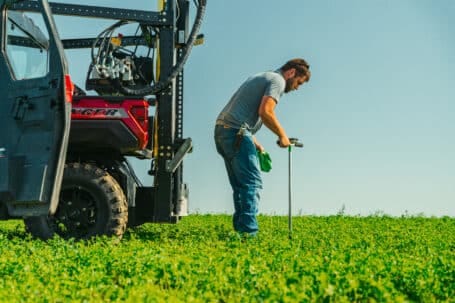
That measurement layer is where ChrysaLabs works: it is the first direct-contact proximal sensing technology validated by a third-party auditor (Bureau Veritas North America) to be used under Verra’s VM0042. Learn what that validation covers.
3. Permanence safeguards
Soil carbon can be released if practices stop, so it is classed as a temporary removal. Each registry handles that risk in its own way. Under Verra’s VCS, projects rate their reversal risk and set aside non-tradable buffer credits that are cancelled if a reversal happens; since December 2025, a pilot also allows insurance or a dedicated fund instead (Verra). Under CAR’s Soil Enrichment Protocol, the CCP label requires a project implementation agreement with a minimum 40-year commitment. Lower risk ratings, longer farmer contracts and regular re-measurement all support a higher price. Read more in our guide to additionality and permanence.
4. Vintage, region and buyer
Recent vintages (2023 and later) sell for 20 to 40% more than 2018–2020 vintages of the same methodology, according to Senken’s data. Location matters too: in Europe, domestic-origin agricultural credits sell at a premium, and food companies often pay more for projects inside their own sourcing regions. Large buyers tend to negotiate lower prices, and every broker in the chain takes a margin.
5. Documented co-benefits
Once two credits clear the same integrity bar, co-benefits decide which one a buyer chooses. Biodiversity, water quality and farmer income add an estimated €5 to €20 per tonne in Senken’s data, but only when they are documented, not just claimed.
Why buyers value soil carbon credits
Demand is growing. AlliedOffsets’ 2026 soil carbon market report counts 128 identified buyers of soil carbon credits, up from 80 in 2022, with Microsoft, Shell, NW Natural and PetroChina among the largest, and notes that CCP-labeled issuance is rising (AlliedOffsets). In January 2026, Microsoft signed a 12-year agreement to buy 2.85 million soil carbon credits from Indigo Ag.
Soil carbon credits come from farms, which gives buyers benefits most other credit types cannot match:
- Biodiversity: cover crops, diverse rotations and less soil disturbance support soil life, pollinators and field-margin habitat.
- Water and resilience: healthier soils hold more water. In the 2012 U.S. drought, farmers in the national cover crop survey reported average yield gains of 9.6% for corn and 11.6% for soybeans after cover crops (SARE).
- Farmer livelihoods: carbon revenue funds practices farmers would otherwise find too expensive, and fewer tillage passes cut fuel costs.
- A project you can visit: buyers can walk a field and see the soil, which makes the credit tangible in sustainability reports.
- Supply-chain fit: for food and beverage companies, projects can sit inside their own sourcing regions. The GHG Protocol’s Land Sector and Removals Standard (LSRS), effective January 1, 2027, sets accounting rules for land emissions and removals, with traceability requirements (GHG Protocol). See our guide to Scope 3 insetting in agri-food value chains.
Should biodiversity be sold as a separate credit instead? Read our guide to biodiversity credits vs. co-benefits.
5 questions to ask before buying soil carbon credits
- Does the project use a CCP-approved methodology version (for example VM0042 v2.2 or CAR’s Soil Enrichment Protocol v1.1), and does it meet the label’s conditions?
- How was soil organic carbon measured, at what depth, and with what sampling density?
- How is measurement uncertainty quantified, and how does it affect the credited volume?
- What permanence safeguards apply, and how long are the farmer contracts?
- Which co-benefits are documented with data, and can you visit the farms?
How project developers can capture a higher price
- Reduce measurement uncertainty. Better sampling design and direct field measurement mean more of the real carbon gain is credited, at a lower cost per verified tonne. See what drives soil carbon MRV costs.
- Move to a CCP-approved methodology version, such as VM0042 v2.2 or CAR’s Soil Enrichment Protocol v1.1, to qualify for CCP labels.
- Document co-benefits from day one. Baseline photos and simple biodiversity and water indicators are cheap to collect at the start and hard to reconstruct later.
- Secure long-term farmer commitment. Multi-year contracts support both permanence and the story buyers want to tell.
Frequently asked questions
What is a soil carbon credit worth in 2026?
About €15 to €60 per tonne in European deals (Senken data), and roughly $50 to $81 per tonne in US listings (Indigo Ag and Carbonmark). Methodology version, measurement quality, permanence, vintage, region and documented co-benefits explain most of the spread.
Why do soil carbon credit prices vary so much?
Buyers pay for confidence, not just tonnes. Credits from similar farms differ in CCP status, measurement uncertainty, permanence risk, vintage and co-benefits, and buyer identity alone explained 62% of price differences in one study of carbon credit transactions.
Are CCP-labeled soil carbon credits more expensive?
Increasingly, yes: a CCP label with a strong rating adds roughly €5 to €15 per tonne in Senken’s data. The label covers the methodology, not each project, so project-level due diligence still matters.
How does measurement affect the price of a soil carbon credit?
Methodologies credit conservatively when soil carbon estimates are uncertain. Lower uncertainty means more of the real carbon gain is credited and stronger evidence for buyers, which supports a higher price.
Do co-benefits increase soil carbon credit prices?
Yes, once integrity is established. Documented biodiversity, water and farmer benefits can add several euros per tonne and often decide between equally credible credits.
Are soil carbon credits permanent?
Not like durable removals. Soil carbon can be released if practices stop, so standards require buffer pools, insurance or funds, and regular re-measurement. Buyers should check the risk rating and farmer contract length.
Conclusion: in soil carbon, price follows proof
A soil carbon credit is worth more when the buyer can trust how the tonne was measured, how long it will stay in the ground and what else the farm delivers. Measurement is the part we work on every day: see how we help project developers lower uncertainty, or download our eBook on the rise of carbon credits.