Short answer
There is no standard price per acre for soil carbon MRV. The cost depends mostly on four things: how many points you sample, how many of them go to the lab, how deep you measure and how much field logistics the project needs. The reliable way to know your cost is to model it from your own field list and target uncertainty.
- The right metric: total MRV cost per verified tonne, not price per sample. Cheap data with high uncertainty costs you credits.
- The biggest lever: fewer lab samples, replaced by denser in-field measurement and a calibrated model.
- The hidden cost: uncertainty deductions, which reduce the credits issued for the same carbon.
Last updated: October 2026
Soil carbon MRV (measurement, reporting and verification) is one of the largest operating costs of a soil carbon project. It is also one of the least transparent: providers quote per sample, per acre or per project, and the real cost only shows up when uncertainty deductions reduce the credits issued. This guide explains what drives MRV costs under Verra’s VM0042 methodology, how to estimate them for your project, and how to reduce them without weakening the data.
What makes up the cost of soil carbon MRV?
| Cost item | What drives it |
|---|---|
| Sampling design | Number of fields and strata, soil variability, target uncertainty |
| Field operations | Crews, travel between farms, points per acre, sampling depth, terrain and weather windows |
| Laboratory analysis | Number of samples sent to the lab, analyses per sample (SOC, bulk density, carbonates), shipping and preparation |
| Data and modelling | Calibration, QA/QC, stock calculations, uncertainty analysis, reporting |
| Verification | VVB review time, which grows when data is hard to trace or needs rework |
| Uncertainty deductions | Not an invoice, but a real cost: higher uncertainty means fewer credits issued for the same carbon |
Why cost per sample is the wrong metric
A provider that charges less per sample is not necessarily cheaper. If the data carries more uncertainty, the project loses credits at every verification. If the data is hard to trace, verification takes longer and may need extra sampling.
The metric that matters is total MRV cost per verified tonne: everything you spend on measurement, reporting and verification, divided by the credits actually issued.
How to estimate MRV cost for your project
Before asking for quotes, gather the inputs that drive the cost. With them, a provider can give you a real estimate instead of a generic price list.
- Project footprint: total acres, number of fields and farms, and how far apart they are.
- Soil and management variability: soil types, existing soil maps, and the practices being changed.
- Methodology requirements: the VM0042 version, the required depth and the monitoring frequency.
- Target uncertainty: how much uncertainty the project can accept before deductions hurt revenue.
- Expected credit yield: the sequestration you expect per acre and the credit price you plan on.
The last two inputs matter most: they tell you how much each extra sample is worth in protected credits, and therefore when to stop sampling.
Lab-only sampling vs. proximal sensing with lab calibration
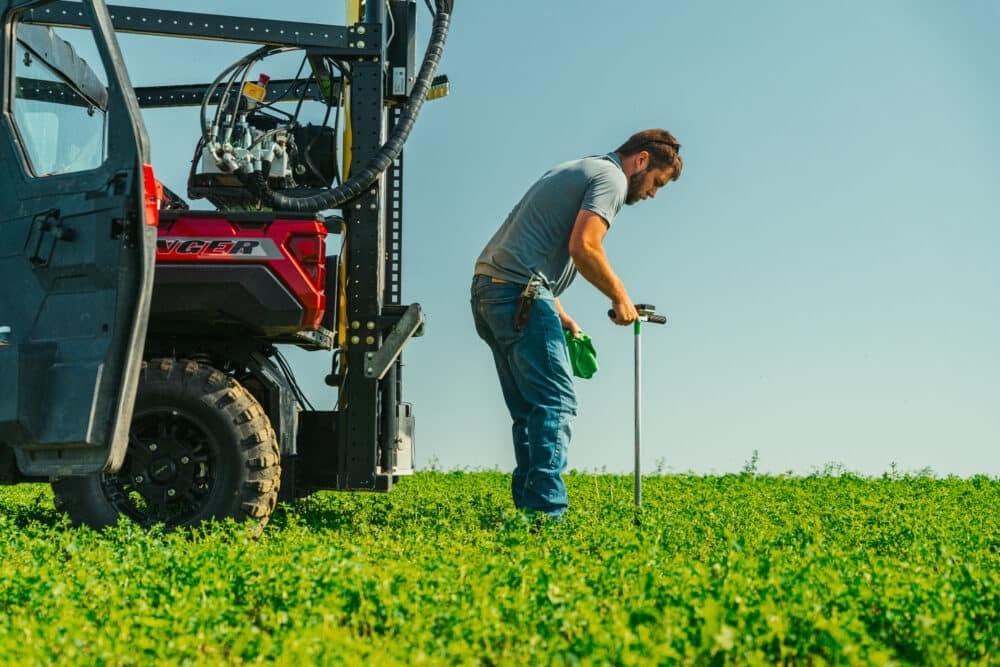
Laboratory dry combustion is the reference method, but every sample costs money and time. That limits how many points a project can afford, and fewer points mean higher uncertainty. Direct-contact proximal sensing measures soil in the field at many more points, and a smaller number of lab samples calibrates the model.
| Lab-only sampling | Proximal sensing + lab calibration | |
|---|---|---|
| Measurement points | Limited by lab budget | Dense in-field coverage |
| Lab samples | Every point | A strategic subset, sized to calibrate and check the model |
| Turnaround | Days to weeks per batch | Readings in the field, lab only for calibration |
| Effect on uncertainty | Higher when samples are sparse | Lower thanks to denser data, if calibration is sound |
5 ways to reduce soil carbon MRV costs
- Stratify on measured soil variability. Grouping similar zones lets you sample less where the soil is uniform and more where it varies.
- Replace part of the lab work with in-field measurement. Keep lab analysis for calibration and checks, not for every point.
- Optimize the number of samples against credit yield. Past a certain point, an extra sample costs more than the credits it protects. Below it, saving on samples costs you credits.
- Measure to the right depth once. Meeting depth requirements from the baseline avoids costly re-sampling later.
- Build traceability in from day one. Clean, georeferenced, versioned data shortens verification and avoids rework.
How ChrysaLabs keeps MRV costs predictable
Our sampling calculator identifies the most profitable sampling strategy for a project by balancing operational costs and carbon credit yield. Direct-contact proximal sensing, validated by Bureau Veritas for use under VM0042, then delivers dense field data with a strategic number of lab samples, at depths down to one meter.
This approach has been applied at scale: 5 million acres measured in 10+ countries, including a 90,000+ acre project with Agoro Carbon Alliance. Read the Agoro use case.
See how it works on our soil carbon MRV page, or ask our team for an estimate based on your field list.
Frequently asked questions
How much does soil carbon MRV cost per acre?
There is no standard price per acre. The cost depends on the number of strata, points per acre, lab samples, sampling depth and field logistics. The most useful figure is total MRV cost per verified tonne, estimated from your own field list and target uncertainty.
What is the biggest cost in soil carbon MRV?
Usually laboratory analysis and field operations. Uncertainty deductions are also a major hidden cost, because they reduce the credits issued.
Does cheaper sampling mean a cheaper project?
Not always. Sparse sampling increases uncertainty, which leads to larger deductions and fewer credits. Compare providers on total cost per verified tonne.
How can project developers reduce soil sampling and lab costs for VM0042 monitoring?
By stratifying on measured soil variability, using in-field proximal sensing for dense coverage, keeping lab analysis for calibration, and optimizing sample numbers against expected credit yield.
What information do I need to get an MRV cost estimate?
Your total acres and number of fields, available soil maps, the VM0042 version and depth requirements, your target uncertainty and your expected credit yield.