
Key facts
- What: ChrysaLabs is the first direct-contact proximal sensing soil technology validated by a third-party auditor for use under Verra’s VM0042 methodology.
- Who validated it: Bureau Veritas North America, an independent certification body.
- Against what: VM0042 v2.1 (Improved Agricultural Land Management), including Appendix 4 on emerging soil organic carbon (SOC) measurement technologies.
- Why it matters: project developers can use in-field proximal sensing data in VM0042-aligned projects, with fewer laboratory samples and faster measurement campaigns.
- Scale behind it: 400,000 ground-truth data points, 5 million acres measured, 10+ countries.
Last updated: October 2026
Carbon markets have long faced a challenge: how to measure soil carbon at scale without losing scientific rigour. ChrysaLabs has now demonstrated that it is possible. After an independent review by Bureau Veritas North America, the world’s largest certification body, ChrysaLabs becomes the first direct-contact proximal sensing soil measurement technology validated by a third-party auditor to be used under Verra’s VM0042.
The validation confirms that ChrysaLabs’ methodology delivers a credible, standards-aligned approach for VM0042 soil carbon measurement, including Appendix 4 for emerging technologies. In practice, it demonstrates that direct-contact proximal sensing can meet international requirements for high-integrity carbon credits.
What is VM0042?
VM0042 is Verra’s methodology for Improved Agricultural Land Management under the Verified Carbon Standard (VCS). It quantifies greenhouse gas emission reductions and soil organic carbon removals from practices such as reduced tillage, cover crops, improved fertilizer use, residue management and grazing management.
Two versions are currently active: v2.1 (since September 2024) and v2.2 (since October 2025). VM0042 v2.2 is approved by the ICVCM as eligible for the Core Carbon Principles (CCP) label. Source: Verra, VM0042 v2.2.
Which soil carbon measurement methods does VM0042 accept?
For projects seeking CCP-labelled credits under VM0042 v2.2, Verra lists the accepted techniques for measuring SOC content:
- Dry combustion (Dumas method), the laboratory reference;
- Infrared spectroscopy (NIR, Vis-NIR, MIR), following Appendix 4 of the methodology;
- Laser-induced breakdown spectroscopy (LIBS), following Appendix 4;
- Inelastic neutron scattering (INS), following Appendix 4;
- Walkley-Black (wet oxidation) and loss on ignition, under the conditions set in the methodology.
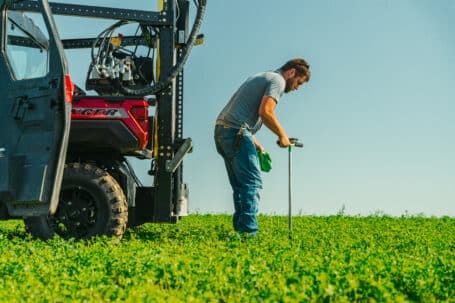
ChrysaLabs uses direct-contact proximal sensing in the field, calibrated against laboratory reference samples. Bureau Veritas reviewed this approach and confirmed its alignment with VM0042 v2.1, including the section covering technology-based SOC methods.
| Approach | Role in a VM0042 project | Main trade-off |
|---|---|---|
| Laboratory dry combustion only | Reference method for baseline and verification | Accurate, but slow and costly at scale |
| Direct-contact proximal sensing + lab calibration (ChrysaLabs) | Dense in-field SOC measurement, with a strategic subset of lab samples | Requires project-specific calibration, which ChrysaLabs builds |
| Satellite or remote sensing alone | Useful for stratification and sampling design | Not a listed technique for measuring SOC content |
Independent validation by Bureau Veritas
Bureau Veritas reviewed ChrysaLabs’ approach to soil organic carbon (SOC) measurement and confirmed its alignment with VM0042 v2.1 for Improved Agricultural Land Management. This includes the section covering technology-based SOC methods.
For the first time, a third-party auditor validated the scientific accuracy and repeatability of proximal sensing soil carbon measurement in the field. As a result, project developers can integrate ChrysaLabs’ data into VM0042-aligned carbon projects with confidence.
“This validation shows that next-generation soil sensing can deliver lab-grade rigour while accelerating the path to market,” said Samuel Fournier, CEO of ChrysaLabs. “It’s a turning point for carbon farming, giving developers the confidence to build measurable, verifiable, and bankable projects that can now scale with credibility, lower risk, and meet the highest global standards.”
How ChrysaLabs fits into a VM0042 project
- Sampling design. Uncertainty-driven stratification and digital soil mapping, so every sample adds information.
- In-field measurement. Dense, rapid probe measurements at variable depths down to one meter, to meet protocol depth requirements.
- Laboratory calibration. A strategic number of lab samples anchors a project-specific model.
- Data management. Probe, lab and spatial data flow into an automated pipeline with QA/QC, version control and audit-ready documentation.
- Modelling and reporting. Predictions with quantified uncertainty, ready for VM0042-aligned reporting and verification.
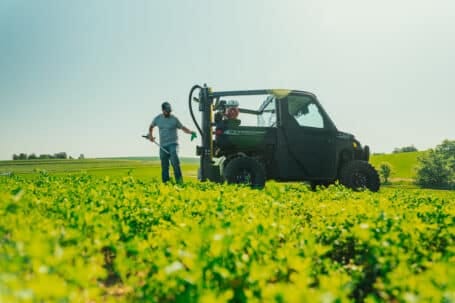
Field operations are handled end to end by trained crews. See the full workflow on our soil carbon MRV page.
A new benchmark for scalability and cost-efficiency
Until now, soil carbon projects faced a tradeoff between scientific rigour and cost. Laboratory analysis provides accuracy but remains slow and expensive. On the other hand, many emerging tools lacked regulatory acceptance. This validation changes that balance.
ChrysaLabs now enables VM0042-compliant soil measurement at a fraction of the traditional cost, while preserving scientific quality. Developers gain faster baselines, more frequent monitoring, and stronger confidence in resulting credits.
Estimate your own project: our sampling calculator balances operational costs and carbon credit yield to find the most profitable sampling strategy. Try the approach on the MRV page.
From validation to bankability
The validation also changes how developers view soil measurement. Instead of a cost center, soil carbon data becomes an asset aligned with recognized standards. Projects can scale to thousands of hectares without sacrificing accuracy or transparency. With Bureau Veritas acting as an independent auditor, this validation offers a foundation for stronger investor confidence and higher-integrity carbon credits.
Proof at scale: ChrysaLabs supported Agoro Carbon Alliance on a 90,000+ acre project. Read the Agoro use case.
FAQ
Is ChrysaLabs approved by Verra?
Verra approves methodologies, not individual devices. Bureau Veritas North America reviewed ChrysaLabs’ approach to soil organic carbon measurement and confirmed its alignment with VM0042 v2.1, including Appendix 4 for emerging technologies. Each project is still validated and verified by its own validation/verification body (VVB).
Which version of VM0042 does the validation cover?
The Bureau Veritas review was performed against VM0042 v2.1. Both v2.1 and v2.2 are active today. Talk to our team about the version that fits your project.
Does proximal sensing replace laboratory analysis?
No. It reduces the number of lab samples needed. A strategic subset of samples analyzed in the lab calibrates and checks the field measurements.
How deep does ChrysaLabs measure?
At variable depths down to one meter, to meet VM0042 depth requirements.
Who uses ChrysaLabs for VM0042 projects?
Carbon project developers, ag input and biologicals companies, food and beverage companies with Scope 3 programs, and biofuel producers. See our solutions for project developers.
Using ChrysaLabs data in a VM0042 project
Project developers can see how ChrysaLabs supports sampling design, in-field measurement and VM0042-aligned reporting on our soil carbon MRV page and in our solutions for project developers. To discuss a project, talk to our team.