
What Is Carbon Farming?
Carbon farming refers to a set of agricultural land management practices deliberately adopted to increase the rate at which carbon dioxide is removed from the atmosphere and stored in soil organic matter and plant biomass. For a farmer, this means managing your land in ways that build soil organic carbon (SOC) over time, generating measurable, verifiable environmental outcomes that can be monetised through the voluntary carbon market.
The core mechanism is photosynthesis. Plants capture atmospheric CO2 and transfer a portion of that carbon belowground through root systems and decomposing organic matter. When land is managed to favour this process and to minimise carbon losses through tillage, erosion, or bare soil exposure, net carbon accumulation in the soil occurs. That accumulation, when independently measured and verified, can be converted into carbon credits sold to companies seeking to offset or inset their Scope 3 emissions.
Why Soil Organic Carbon Is the Central Metric
Soil organic carbon is the fraction of soil organic matter that consists of carbon compounds derived from decomposed plant and animal material, microbial biomass, and stable humus. It is expressed as a percentage of dry soil mass or in tonnes of carbon per hectare. SOC is the primary measurement target in carbon farming because it serves simultaneously as an indicator of soil health, water-holding capacity, aggregate stability, and climate impact.
In the context of carbon credit generation under methodologies such as Verra VM0042, the change in SOC stock over time is the principal variable used to calculate the volume of CO2-equivalent sequestered. This means your ability to generate and sell credits depends directly on your ability to document a measurable increase in SOC attributable to your management changes.
Common Carbon Farming Practices
Carbon farming is not a single practice. It is a portfolio of management interventions, and their effectiveness varies by soil type, climate, baseline SOC levels, and implementation quality. The following practices have documented evidence for SOC accumulation:
- Cover cropping: Maintaining living root systems in the soil during off-season periods increases rhizodeposition and suppresses erosion-driven carbon loss.
- Reduced or no-till: Eliminating or minimising mechanical soil disturbance preserves soil aggregates that physically protect organic matter from microbial decomposition.
- Improved crop rotations: Introducing high-residue or nitrogen-fixing crops into a rotation increases above- and belowground carbon inputs.
- Compost or organic matter amendments: Direct additions of stabilised organic matter raise SOC levels, though additionality rules in carbon protocols require careful documentation.
- Agroforestry: Integrating perennial woody species into cropping systems adds biomass carbon pools and improves soil structure under canopy zones.
- Improved grazing management: Adaptive multi-paddock grazing reduces overgrazing, allows plant recovery, and maintains root mass and litter inputs.
None of these practices guarantee carbon accumulation in isolation. Soil carbon dynamics are nonlinear, site-specific, and influenced by annual weather variability. This is why measurement is not optional — it is foundational.
How to Measure Soil Organic Carbon: Methods and Standards
Understanding how to measure carbon in soil is essential before enrolling in any carbon programme. Measurement errors or insufficient sampling density directly affect the credibility and volume of credits you can claim. There are three layers to this: field sampling, laboratory analysis, and modelling or quantification frameworks.
Field Sampling Protocol
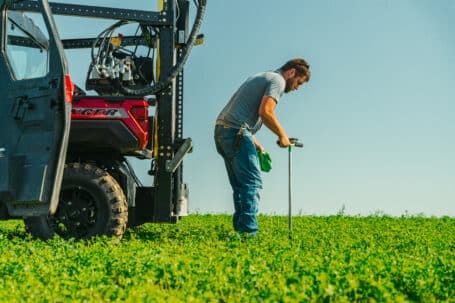
Measuring carbon sequestration in soil begins with a rigorous sampling design. Samples must be collected at consistent depth increments — typically 0–30 cm as a minimum, with deeper horizons (30–60 cm and beyond) increasingly required under methodologies like VM0042. Bulk density must be measured alongside SOC concentration, because carbon stock calculations require both values: SOC stock (t C/ha) equals the product of SOC concentration, bulk density, and sampling depth.
When measuring soil carbon, sample quantity and spatial distribution matter. A minimum of 15 to 30 composite or individual cores per field management zone is standard practice for statistically defensible estimates. Stratification by soil type, landscape position, and historical management history reduces within-field variance and improves the precision of stock change estimates over time.
Laboratory Analysis Methods
Measuring organic carbon in soil at the laboratory stage involves one of two primary methods. Dry combustion (elemental analysis) is the reference method: a soil sample is combusted at high temperature and the CO2 evolved is quantified. This measures total carbon. When inorganic carbonates are present — common in arid and semi-arid soils — a correction step is required to isolate organic carbon.
Loss on ignition (LOI) is a lower-cost alternative but introduces systematic error and is generally not accepted as a stand-alone method under third-party verified carbon protocols. Near-infrared reflectance spectroscopy (NIRS) and mid-infrared spectroscopy (MIR) are increasingly used as high-throughput screening tools, but they require robust local calibration against wet chemistry or dry combustion reference data to be credible.
Measuring soil carbon accurately also requires proper sample handling: field-moist samples must be dried at 105°C, ground, sieved to 2 mm, and stored in controlled conditions to prevent microbial degradation before analysis.
Modelling and Quantification Frameworks
Measuring soil organic carbon at scale often integrates direct measurement with process-based or empirical modelling. The Verra VM0042 methodology, for example, uses a combination of field-measured SOC data and modelled estimates — including tools such as RothC or Century — to calculate baseline trajectories and project future carbon stocks under the intervention scenario. Independent validation by a third party such as Bureau Veritas ensures that both the measurement protocol and the modelling assumptions meet the standard’s requirements for accuracy, conservativeness, and permanence.
From Measurement to Carbon Credits
Once you have documented SOC stock changes through the methods described above, that data feeds into a credit quantification calculation. The net sequestration figure — adjusted for leakage, uncertainty discounts, and buffer pool contributions — determines the number of carbon credits issued. One credit equals one tonne of CO2-equivalent sequestered or avoided.
For farmers, this means that the quality of your sampling and analysis protocol is directly correlated with the number of credits you can claim and the price those credits will achieve in the voluntary carbon market. Buyers of high-integrity agricultural soil carbon credits — including CPG companies running insetting programmes — increasingly require measurement, reporting, and verification (MRV) systems that use direct soil sampling rather than purely modelled estimates.
Frequently Asked Questions
How long does it take to see measurable SOC increases after changing practices?
Detectable changes in SOC stocks typically require three to five years of consistent practice implementation. Annual variability in weather, crop yield, and residue inputs creates noise that can obscure real trends at shorter time horizons. Some methodologies require a minimum baseline period and multiple measurement campaigns to establish a statistically significant change.
Does every field accumulate carbon at the same rate?
No. Sequestration rates vary significantly by soil texture, initial SOC levels, climate, crop type, and management intensity. Sandy soils with low clay content have a lower physical capacity to stabilise organic matter than fine-textured soils. Fields already at or near their SOC saturation point will accumulate carbon more slowly regardless of practice changes.
What is the difference between soil carbon sequestration and soil carbon storage?
Sequestration refers to the active process of removing CO2 from the atmosphere and converting it into soil organic matter — a rate measured over time. Storage refers to the total stock of carbon held in the soil at a given point in time. For carbon credit purposes, what is measured and credited is the net change in SOC stock between a baseline measurement and a subsequent verification measurement, expressed as tonnes of CO2-equivalent per hectare per year.